generative ai • live 2026
Creating a Generative EMR
Redefining manual form filling for EMRs
Role
Product Designer & Solution Architect
Timeline
3 Months
Team
2 Product Designers & 3 Product Mangers
overview
What if we could transform a traditional EMR into an intelligence-assisted clinical documentation system?

Existing EMR at Bajaj Finserv Health
Problem
Clinical Documentation Today
How a Clinician’s Time Is Actually Spent
45% EMR
30% patient
25% admin
EMR at Bajaj Finserv Health
7,16,280
Prescriptions Generated as compared to 2,21,728 in 2022
223% from the old version
15,798
Active Doctors as compared to 7,160 in 2022
75% from the old version
key challenges
The goal was not to redesign the system, but to evolve it without disruption.
01
Not a greenfield build
the EMR already had a live backend, data models, and workflows. With everything handled in-house, design and engineering were tightly coupled."
02
Doctors work in time-sensitive, high-stress settings and resist tools that disrupt their workflow
even small friction causes rejection."
03
The EMR's structure wasn't the problem
manual form-filling was
THE approach
Given the technical and behavorial constraints, the approach focused on reducing ambiguity early, validating feasibility fast, and grounding decisions in market reality and working prototypes.
Defining Where AI Actually Helps
What We Did
Use cases
Competitive Benchmarking & Market Understanding
competitor analysis
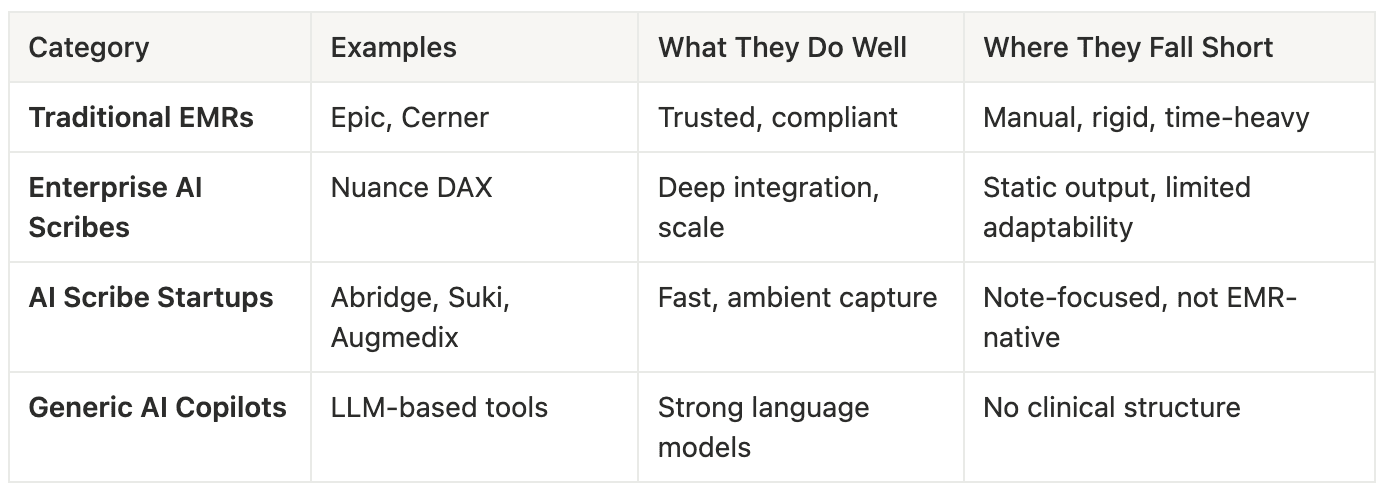
Competitive Benchmarking
Clear differentiation:
Most tools generate notes. This project focuses on generating the EMR itself.
Prototyping Through Working Proofs, Not Static Screens
Real-time AI behavior couldn't be shown through static mockups - so we shifted to functional proofs of concept instead of screens.
tools used

Google AI Studio for rapid AI experimentation and POCs


Claude + Cursor to build and test a functioning prototype that reflected real EMR behavior
Timeline
Whiteboarding


The best way to get our thoughts down
patient overview

detailed record about the patient

The Generative EMR as a feature
Voice and chat input where doctors can record sessions and the EMR automatically fills up based on the transcribed text.
Smart fill with components that are not mentioned being added to the EMR
Personalisation and context awareness


the 3 ways a doctor will interact with the platform
Before and after
Next steps
After building the feature and testing it out within the company it is time to go live
Final designs
Chat Bot
Texting anything can help fill fields, add new fields and finish the EMR faster
Just Speak!
Entire sessions can be recorded to fill fields in the fastest way possible
Key learnings
This was a the first project where I implemented an AI first feature
End-to-End Ownership
Static Designs Are Insufficient for Intelligent Systems
The Real Shift Is Structural, Not Cosmetic